
If water is actively entering your home right now, stop reading and do three things first: shut off the main water supply valve, cut power to any flooded rooms at the breaker box, and move out of standing water. Once those are done, come back here — the next 24 hours will determine whether you’re dealing with a manageable cleanup or a months-long reconstruction project.
Why the Clock Starts the Moment Water Appears
Water doesn’t wait. Within the first hour, it migrates through drywall, under flooring, and into wall cavities faster than most people expect. Hardwood floors begin to cup and buckle within 2–4 hours of saturation. By the 24-hour mark, mold spores — which are always present in the air — can begin colonizing wet organic materials like wood framing, drywall paper, and insulation. By 48–72 hours, that colonization accelerates significantly.
San Diego’s climate adds a wrinkle: the region’s relatively mild, dry air can create a false sense of security. A wet subfloor in a Clairemont bungalow or a Mission Hills craftsman can feel dry to the touch on the surface while holding moisture 3–4 inches deep, well past where a hand-check can reach. That’s why drying time is measured with moisture meters, not by feel.
The faster you act in the first 24 hours, the more of your home — and your belongings — you save.
Immediate Steps: What To Do in the First Hour
Work through this in order. Skipping steps or doing them out of sequence can make things worse.
-
Shut off the water source. If a pipe burst or an appliance line failed, find your main shutoff valve — in most San Diego homes it’s near the street-side meter box or in a utility closet — and turn it clockwise until it stops. If the source is a roof leak or storm intrusion, you can’t stop the water, but you can limit spread by moving items and placing towels or buckets strategically.
-
Cut power to affected rooms. Go to your breaker panel and switch off any circuit that serves a flooded room. Don’t step into standing water to reach a switch — trip the breaker first. If your panel itself is in a flooded area, call your utility (SDG&E in most of San Diego County) and ask them to cut power at the meter before you enter.
-
Document everything before you touch it. Open your phone’s camera and walk through the damage. Photograph standing water levels, waterlines on walls, soaked furniture, and any visible structural damage. This footage is your insurance claim. Take more than you think you need — adjusters look for context, not just close-ups.
-
Remove standing water if it’s safe to do so. A wet/dry shop vac handles small volumes. Towels and mops work for thin layers. For anything deeper than an inch across a significant area, you’re past DIY territory — water that deep has almost certainly reached the subfloor and wall cavities.
-
Move salvageable items out of the wet zone. Furniture, rugs, electronics, and documents should come out of the affected space immediately. Wet rugs left on hardwood floors will transfer dye and accelerate wood damage. Place aluminum foil under furniture legs if you can’t move a piece entirely.
-
Open windows and run fans — but only if outdoor humidity is low. In San Diego, this is often a reasonable option. If it’s a marine-layer morning with coastal fog, hold off — pushing humid outdoor air into a wet space can slow evaporation. Check the humidity before you ventilate.
What Not To Do
Some instincts that feel helpful will actually extend your recovery timeline or create new problems.
- Don’t use a household dehumidifier as your primary drying tool. Residential dehumidifiers aren’t built for structural drying. They’ll run continuously, pull minimal moisture from building materials, and give you a false sense of progress while mold begins establishing itself in the wall cavity behind them.
- Don’t turn on your HVAC system to dry things out. If water has reached your ductwork — which happens frequently with slab leaks or ceiling collapses — running the system spreads contaminated air and potentially mold spores throughout the entire house.
- Don’t rip out wet drywall immediately. It feels productive, but opening walls before moisture mapping means you won’t know what you’re dealing with. A professional will use thermal imaging and moisture meters to identify exactly where the water traveled before any demolition begins.
- Don’t assume the damage is only where you can see it. If the leak is behind drywall, you’ll often see a soft spot, a bubbling paint surface, or a faint musty smell before you see any visible staining. By the time a waterline appears on a wall, the insulation behind it has been wet for hours.
- Don’t delay calling your insurance company. Most homeowner policies require prompt notice of a loss. Waiting even a day or two can complicate your claim. Call your agent, not just the 800 number on your card — your agent can advocate for you during the claims process.
When To Call a Professional Restoration Company
Some water damage situations are genuinely manageable with towels, fans, and time. A small appliance drip caught immediately, a toilet overflow limited to tile flooring, a minor window leak on a painted surface — these can often be handled without professional help if you act within the first hour and can confirm the materials dried completely.
Call a professional if any of the following are true:
- Water covered more than roughly 10 square feet of floor area
- The water was standing for more than an hour before you found it
- The source was a toilet, sewage line, or any water that may have been contaminated (this is Category 2 or Category 3 water and requires different handling protocols)
- You can smell something musty within 12–24 hours of the event
- The water reached carpet, hardwood, engineered flooring, or any area with a subfloor beneath it
- The leak originated behind a wall, under a slab, or in a ceiling
A qualified water damage restoration company will bring industrial air movers, desiccant or refrigerant dehumidifiers, thermal imaging cameras, and calibrated moisture meters — equipment that can dry a structure in 3–5 days that would take weeks to dry on its own, if it dried completely at all. IICRC-certified technicians follow the S500 Standard for Professional Water Damage Restoration, which sets the drying targets your insurance company will expect to see documented.
The Longer Recovery: Days 2 Through 30
Once the immediate emergency is stabilized, the restoration process moves into phases that most homeowners don’t anticipate.
Days 2–5 are typically active drying. Equipment runs continuously, and a technician should check moisture readings daily to confirm drying progress and adjust equipment placement. This phase ends when all affected materials reach acceptable moisture content — not when things feel dry.
Days 5–10 often involve decisions about what can be saved versus what needs to be removed. Wet insulation almost always needs to come out. Drywall below a certain moisture threshold can sometimes dry in place; above it, removal is more cost-effective than the mold risk of leaving it.
Weeks 2–4 are reconstruction: new drywall, paint, flooring, trim. If your insurance claim is moving, this phase is often delayed by adjuster schedules and contractor availability — which is one reason starting the claims process on day one matters so much.
Throughout all of it, keep your own records: photos at each phase, a written log of who was on-site and when, copies of all moisture readings and drying logs. A reputable restoration company will provide these, but having your own copies protects you.
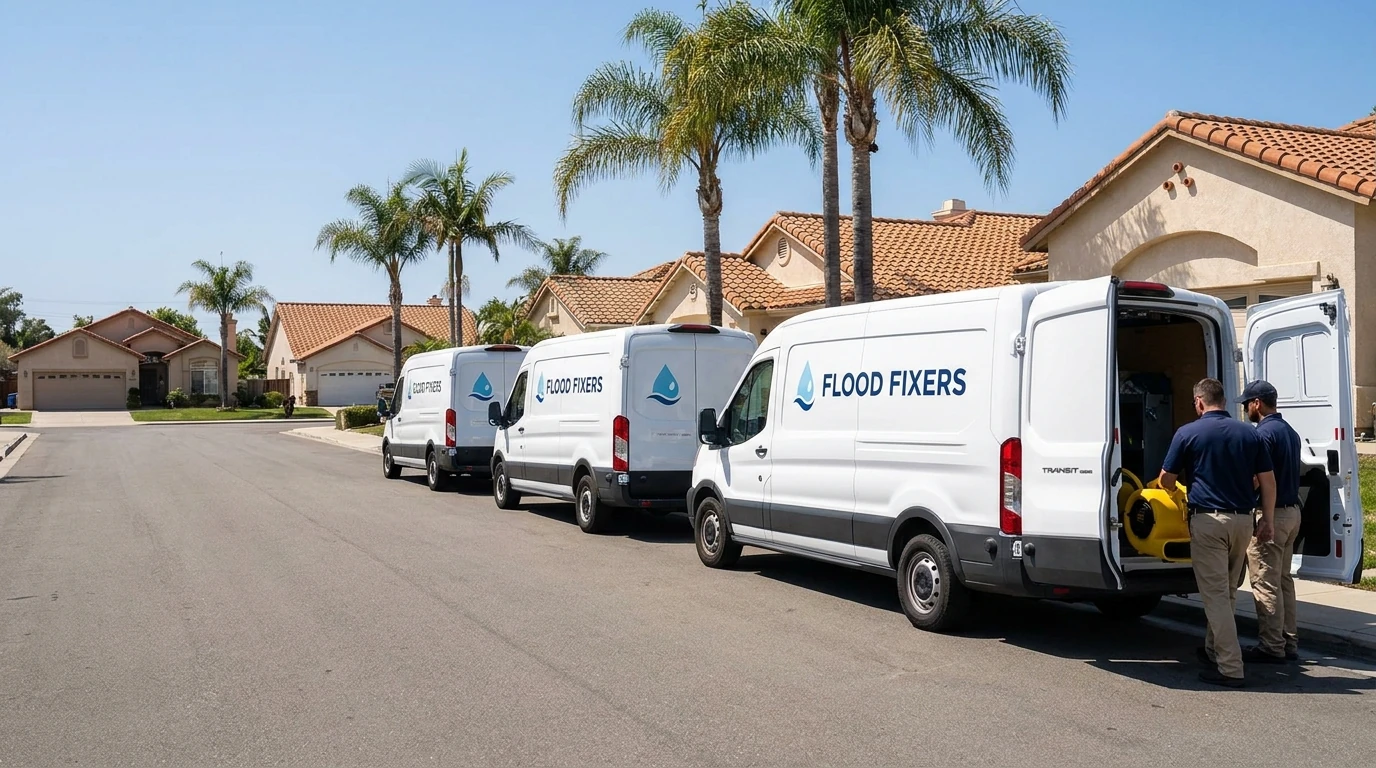
If you’re reading this in the middle of an active situation in San Diego, Flood Fixers responds 24 hours a day. A technician can typically be on-site within 60–90 minutes to assess the damage, begin extraction, and walk you through the insurance process. Call (855) 204-1124 — or keep working through the steps above if the situation is contained and you’re still in the information-gathering phase. Either way, the next few hours matter.