
Basement Flooding Cleanup in San Diego
24/7 basement flooding cleanup in San Diego and surrounding areas. IICRC-certified, insurance billing accepted. Call (855) 204-1124.
You walked downstairs and felt it before you saw it — that cold, wet give under your feet, the smell of disturbed earth and standing water, maybe the low hum of a sump pump that ran out of time. Basement flooding moves fast: within 24 hours, drywall wicks moisture up the wall, wood subfloor panels begin to swell and separate, and the conditions for mold colonization are already in place. The clock on a flooded basement cleanup starts the moment the water stops rising, not when it’s convenient.
What basement flooding cleanup actually involves
Flooded basement cleanup is categorically different from wiping up a burst pipe in a bathroom. You’re typically dealing with a large volume of water — sometimes thousands of gallons — in a partially or fully enclosed space with limited airflow, concrete or block foundation walls that absorb moisture slowly, and a mix of finished and unfinished materials that respond to saturation in very different ways.
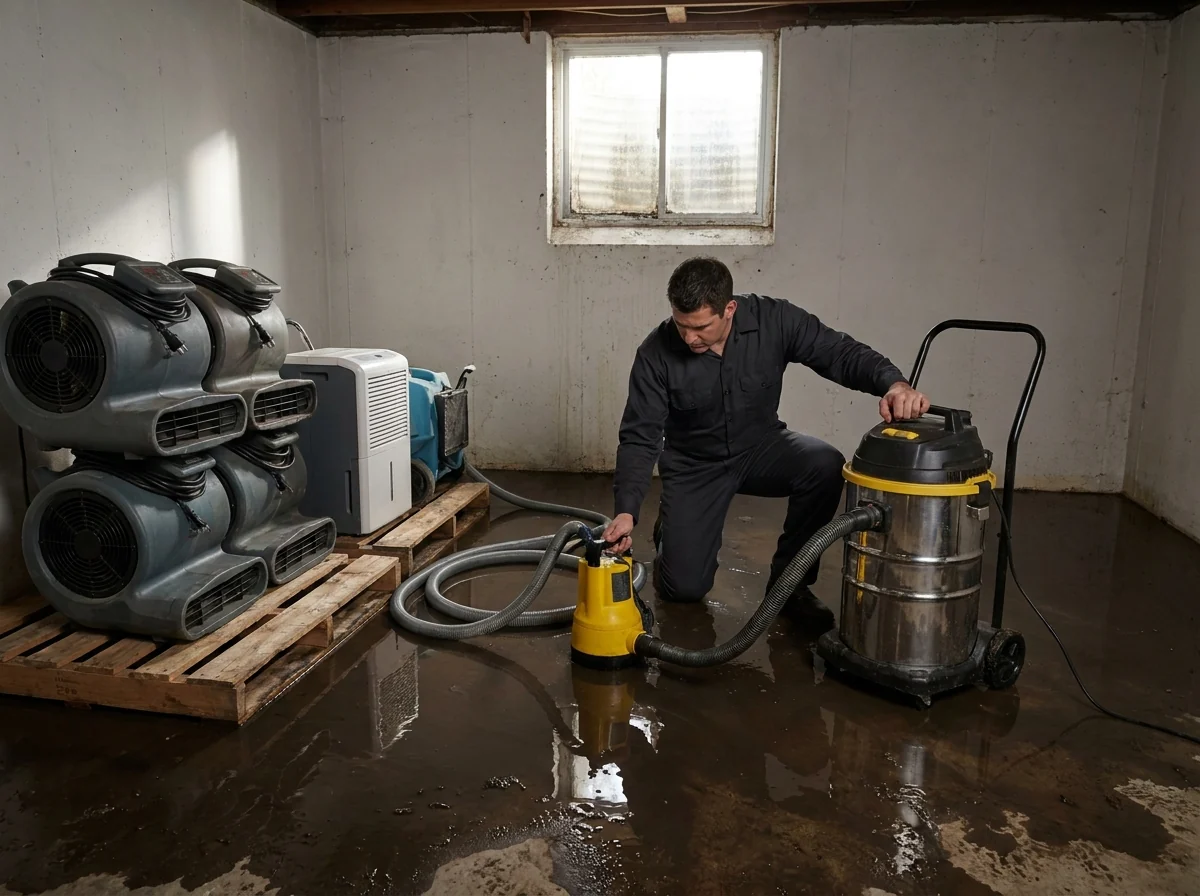
The work involves industrial-grade truck-mounted or portable extraction units pulling standing water from the floor, followed by targeted drying equipment — high-velocity air movers and refrigerant or desiccant dehumidifiers — positioned to create deliberate airflow patterns across walls, floors, and cavities. Moisture meters and thermal imaging cameras map what you can’t see: water trapped behind drywall, under flooring, inside wall cavities, and in the slab itself.
Timeline depends heavily on water category and how long it sat. Clean water from a failed sump pump or foundation seepage (Category 1) in a finished basement typically requires 3–5 days of active drying with daily monitoring. Groundwater intrusion or sewage backflow (Category 3) requires a longer remediation window, material removal, and antimicrobial treatment before drying equipment even goes in.
Our process
-
Emergency extraction and safety assessment. We arrive, assess the water source and category, and begin extraction immediately. If there’s any indication of sewage contamination or electrical hazard, that determines our PPE level and the order of operations before equipment is placed.
-
Moisture mapping and material triage. Using thermal imaging and pin/pinless moisture meters, we document the full scope of saturation — including walls, framing, and concrete — before touching a single piece of drywall. This documentation matters for your insurance claim and prevents guesswork about what needs to come out.
-
Selective demolition and contamination control. Saturated drywall, insulation, and flooring that can’t be dried in place get removed — typically cut to flood cuts 12–18 inches above the visible water line to expose the wet framing behind. For Category 2 or 3 water, antimicrobial application happens before drying equipment is placed.
-
Structural drying with daily monitoring. Air movers and dehumidifiers run continuously. We check moisture readings every 24 hours and log them — this isn’t set-it-and-forget-it. Equipment placement shifts as materials dry unevenly. We don’t pull equipment until readings confirm the structure has reached its dry standard.
-
Final documentation and clearance. Before we close out, you receive a drying log with daily moisture readings, photos, and a summary of materials removed. That package is what your insurance adjuster and any future contractor need to proceed with confidence.
What separates a good basement flooding response from a bad one
The most common mistake in flooded basement cleanup is skipping the moisture mapping step and going straight to drying based on what’s visibly wet. Water in a basement follows the path of least resistance — it pools under floating floors, travels along the bottom plate of framed walls, and saturates concrete block cores that look dry on the surface. Missing those pockets means drying equipment runs for days while hidden moisture feeds mold growth inside the wall cavity.
A second failure point is misclassifying the water source. Groundwater that enters through foundation cracks or a failed sump during a storm is almost always Category 3 — it has contacted soil, which carries bacteria and organic contaminants. Treating it as clean water and skipping antimicrobial protocol is a mistake that insurance adjusters increasingly flag, and one that creates liability for the contractor.
Good operators also document everything before demolition begins. Photos of water lines, moisture meter readings at multiple heights, and thermal images of affected walls create an objective record. Without that, disputes about scope — what was wet, what needed to come out — become difficult to resolve.
Seasonal and regional considerations
San Diego doesn’t get the freeze-thaw basement flooding that batters homes in colder climates, but the region has its own pattern. The atmospheric river events that roll through between November and March can overwhelm drainage systems and push groundwater up against foundations that were built without modern waterproofing standards — particularly in older neighborhoods like North Park, Normal Heights, and parts of Chula Vista where homes date to the 1940s–1960s. Canyon-adjacent properties in Mission Hills, Kensington, and Tierrasanta face hillside runoff that concentrates against downslope foundation walls. After a dry summer, the ground’s reduced absorption capacity means the first heavy rain of the season hits especially hard.
Service area
Flood Fixers handles basement flooding cleanup across San Diego County, including Chula Vista, El Cajon, Santee, La Mesa, Escondido, Oceanside, and surrounding communities. City-specific pages detail local response times and any regional considerations particular to those areas.
If water is in your basement right now, call (855) 204-1124 — the sooner extraction starts, the shorter your drying timeline and the smaller your total restoration scope. Schedule your basement moisture assessment today.
Frequently Asked Questions
How does water category affect what gets removed versus what gets dried in place during a basement flood?
What does a flood cut mean, and why is it done at a specific height rather than just removing visibly wet drywall?
How long does structural drying typically take for a finished basement after flooding?
What should I do — and not do — while waiting for the extraction crew to arrive?
What does the drying log include, and why does it matter for my insurance claim?
Looking for the best basement flooding cleanup company in San Diego?
Flood Fixers provides basement flooding cleanup in San Diego, CA and the surrounding area. Customers rate us 5.0 out of 5 stars across 9 Google reviews. We answer calls 24/7 — call (855) 204-1124 for immediate help.
Need Basement Flooding Cleanup now?
We respond 24/7 across San Diego and surrounding CA cities.
Related Coverage
- Our Restoration Services
- Contact Flood Fixers
- Basement Flooding Cleanup in Carlsbad
- Basement Flooding Cleanup in Chula Vista
- Basement Flooding Cleanup in El Cajon
- Basement Flooding Cleanup in Encinitas
- Basement Flooding Cleanup in Escondido
- Basement Flooding Cleanup in La Mesa
- Basement Flooding Cleanup in National City
- Basement Flooding Cleanup in Oceanside
- Basement Flooding Cleanup in Poway
- Basement Flooding Cleanup in San Marcos
- Basement Flooding Cleanup in Santee