Flood Damage Restoration in San Diego
24/7 flood damage restoration in San Diego and surrounding areas. IICRC-certified, insurance billing accepted. Call (855) 204-1124.
What happens in the first 24 hours matters more than anything else
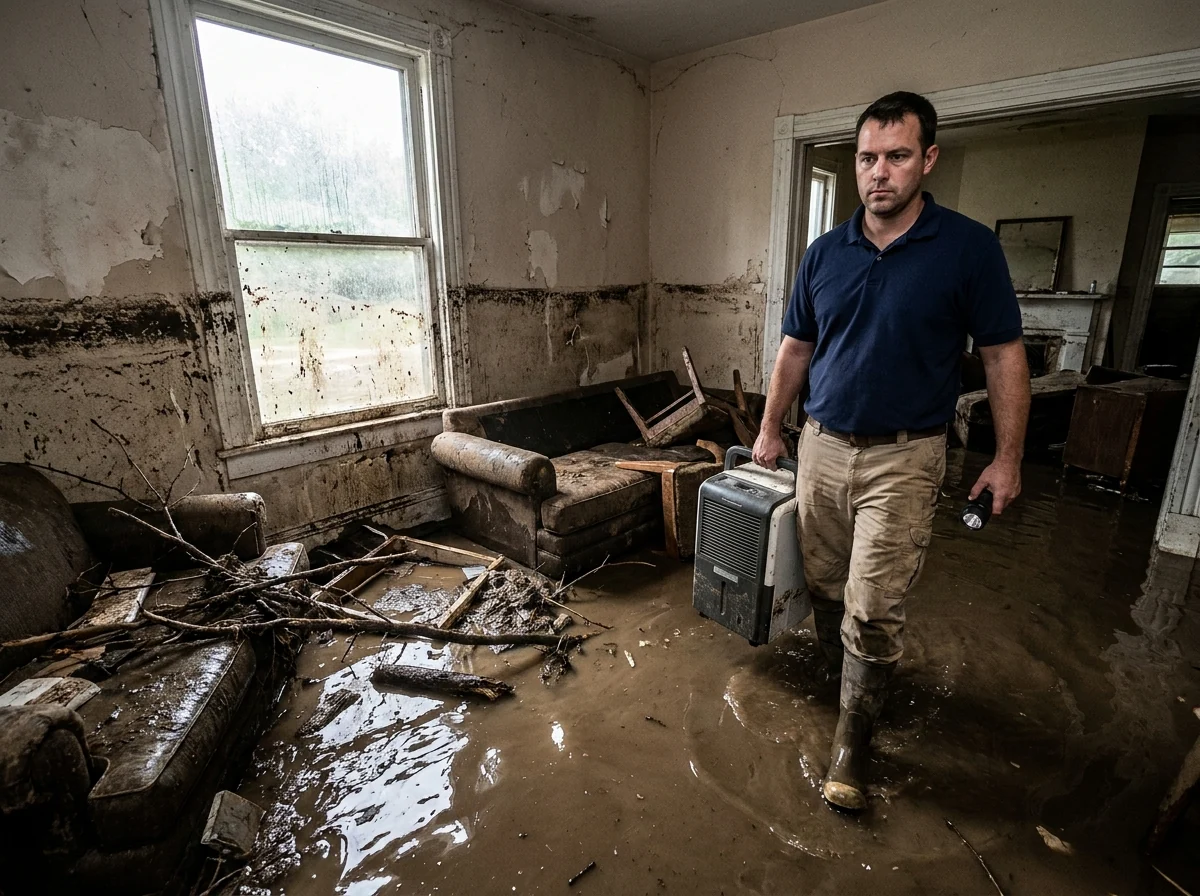
Floodwater doesn’t wait. Whether a storm drain backed up into your garage, a creek jumped its banks into your living room, or a city main broke and pushed Category 3 water through your foundation wall, the clock starts the moment water touches your subfloor. Within 24 to 48 hours, wet drywall begins to delaminate, wood framing absorbs enough moisture to warp, and the conditions for mold colonization are already in place. Flood damage restoration is the race against that timeline — and winning it requires more than shop vacs and box fans.
What flood damage restoration actually involves
Flood cleanup is not the same as mopping up a burst pipe. Floodwater — especially water that has traveled over ground, through storm drains, or up through a sewer lateral — is classified as Category 3 (“black water”) under IICRC S500 standards. That means it carries bacteria, sewage, pesticides, and other contaminants that require a fundamentally different response than a clean-water appliance leak.
The work begins with high-capacity truck-mounted extraction units that can pull hundreds of gallons from carpet, pad, and subfloor in a single pass — equipment that bears no resemblance to the portable extractors a general handyman might rent. Once standing water is removed, the focus shifts to structural drying: commercial-grade desiccant or refrigerant dehumidifiers pulling moisture out of wall cavities and floor assemblies, and high-velocity air movers positioned to create a drying chamber inside the affected space.
Moisture mapping with thermal imaging cameras and calibrated pin/pinless meters tracks the drying progress daily. In San Diego’s coastal neighborhoods — where ambient humidity regularly sits above 70% in summer — passive drying without industrial dehumidification can actually stall or reverse progress. The goal is to reach IICRC-standard dry readings (typically below 16% moisture content in wood, below 0.5% in concrete slabs) before any reconstruction begins.
Timeline: most residential flood jobs reach structural dryness in 3 to 5 days with proper equipment density. Slab-on-grade homes common in South Bay communities like Chula Vista and National City often take longer because concrete holds moisture deep and releases it slowly.
Our process
-
Rapid site assessment and water classification. Before a single pump runs, the source and category of water is confirmed. Floodwater from a storm event or sewer backup is treated as contaminated from the start — this determines what PPE the crew wears, what materials can be dried in place versus removed, and how the job is documented for your insurance adjuster.
-
Contaminated water extraction and gross debris removal. Truck-mounted extractors remove standing water while technicians clear sediment, debris, and saturated materials that cannot be salvaged. Contaminated porous materials — carpet, pad, drywall below the flood line — are bagged, inventoried, and removed per EPA guidelines for Category 3 waste.
-
Antimicrobial treatment of affected surfaces. All hard surfaces that contacted floodwater are treated with EPA-registered antimicrobials before drying equipment is placed. This step is frequently skipped by less-experienced operators and is one of the first things a public adjuster will look for in the job documentation.
-
Structural drying with daily moisture monitoring. Dehumidifiers and air movers are placed according to a calculated equipment density (not just “a few machines in the corner”). Moisture readings are logged at each monitoring point every 24 hours and provided to you and your insurer as a drying log — the paper trail that proves the job was done to standard.
-
Post-drying inspection and clearance documentation. When all monitored points reach target moisture levels, a final inspection confirms no hidden wet pockets remain in wall cavities or under flooring. A written clearance report is generated before any reconstruction scope is written, so new materials are never installed over wet framing.
What separates a good flood response from a bad one
The most common failure in post-flood restoration is treating Category 3 water like Category 1. Crews that extract the water, run fans for a few days, and close the job without antimicrobial treatment or a documented drying log are leaving your home — and your insurance claim — exposed. Mold can begin colonizing within 48 to 72 hours on wet drywall paper; if the job was closed without reaching true structural dryness, you may be looking at a mold remediation project six weeks later that your insurer will dispute because the original drying wasn’t documented.
Insurance adjusters and independent adjusters specifically look for: water category documentation, moisture logs with dated readings, antimicrobial application records, and a materials removal inventory. A restoration company that can’t produce those on request is a company that may cost you more in the long run.
Experienced operators also check for secondary migration — water that wicked laterally into adjacent rooms or vertically into ceiling assemblies from a floor above. Flood damage in one room rarely stays in one room.
Seasonal and regional considerations
San Diego’s Mediterranean climate creates a narrow but intense flood season. The region receives the majority of its annual rainfall between November and March, and the combination of hardpan soils, concrete-heavy urban drainage, and hillside grading means water moves fast and accumulates in low-lying areas quickly. Communities in Mission Valley, Santee, and along the San Diego River corridor have well-documented flood exposure during atmospheric river events.
In drier months, flood calls still come — from slab leaks that go undetected, from HOA irrigation systems that oversaturate shared walls, and from aging cast-iron sewer laterals that back up without warning. Year-round humidity along the coast means drying timelines in neighborhoods like Ocean Beach or Pacific Beach require more dehumidification capacity than inland areas like El Cajon or Lakeside.
Service area
Flood Fixers handles residential and commercial flood damage restoration across San Diego County, including Chula Vista, National City, El Cajon, Santee, La Mesa, Escondido, Oceanside, and surrounding communities. Each city-specific page covers local considerations in more detail.
If your home or property has taken on floodwater, call (855) 204-1124 now to start your flood damage assessment and get extraction equipment moving toward your address.
Frequently Asked Questions
What is the difference between Category 1, 2, and 3 floodwater, and why does it change how my home is treated?
How long does structural drying take after a flood, and what affects that timeline?
Which materials typically have to be removed after a Category 3 flood, and which can be dried in place?
What documentation should I expect from a flood restoration company for my insurance claim?
What should I do — and not do — while waiting for the restoration crew to arrive?
Looking for the best flood damage restoration company in San Diego?
Flood Fixers provides flood damage restoration in San Diego, CA and the surrounding area. Customers rate us 5.0 out of 5 stars across 9 Google reviews. We answer calls 24/7 — call (855) 204-1124 for immediate help.
Need Flood Damage Restoration now?
We respond 24/7 across San Diego and surrounding CA cities.
Related Coverage
- Our Restoration Services
- Contact Flood Fixers
- Flood Damage Restoration in Carlsbad
- Flood Damage Restoration in Chula Vista
- Flood Damage Restoration in El Cajon
- Flood Damage Restoration in Encinitas
- Flood Damage Restoration in Escondido
- Flood Damage Restoration in La Mesa
- Flood Damage Restoration in National City
- Flood Damage Restoration in Oceanside
- Flood Damage Restoration in Poway
- Flood Damage Restoration in San Marcos
- Flood Damage Restoration in Santee