
The short answer: it depends on how the water got in. Homeowners insurance typically covers sudden, accidental water damage — a pipe that bursts overnight, a washing machine hose that lets go, a dishwasher that overflows. It almost never covers flooding from outside your home, and it won’t cover damage that built up slowly over time because of a leak you could have caught. Knowing which category your damage falls into before you call your adjuster can save you hours of frustration and thousands of dollars in denied claims.
The Core Rule Insurers Use: Sudden vs. Gradual
Every standard homeowners policy (HO-3 is the most common form in California) draws a hard line between two types of water damage.
Sudden and accidental damage is generally covered. Examples:
- A supply line behind your refrigerator fails while you’re at work.
- A pipe freezes and bursts during an unusual cold snap — rare in San Diego, but it happens in inland areas like El Cajon or Ramona when temperatures dip below 30°F.
- A toilet overflows because a flapper valve failed, not because of a clog you ignored.
- A neighbor’s upstairs unit floods and water comes through your ceiling (in a condo or townhome).
Gradual damage is almost always excluded. Examples:
- A slow drip under the kitchen sink that warped the cabinet floor over six months.
- A roof flashing that’s been leaking for two rainy seasons and finally rotted the sheathing.
- A shower pan that’s been seeping into the subfloor for years.
Insurers call gradual damage a maintenance issue. Their argument: you had the opportunity to find and fix it. Whether or not that’s fair, it’s the language in your policy, and adjusters are trained to look for evidence of long-term moisture — staining patterns, mold rings, corroded fasteners — that suggest the damage didn’t happen overnight.
What’s Definitely NOT Covered (Without a Separate Policy)
Two categories trip up San Diego homeowners more than any other.
Flood damage from outside your home — storm surge, heavy rain that overwhelms a street drain, water that sheets across your yard and enters through the garage — is excluded from every standard homeowners policy in the country. You need a separate flood insurance policy, either through FEMA’s National Flood Insurance Program (NFIP) or a private carrier. If you’re in a FEMA-designated flood zone near the San Diego River, Mission Bay, or low-lying areas in Chula Vista, this matters.
Sewer and drain backup is also excluded unless you’ve added a specific endorsement. If the city sewer backs up into your floor drain during a heavy rain event — something that happens in older neighborhoods with combined sewer systems — your base policy won’t respond. The endorsement is usually inexpensive (often $50–$100/year) and worth asking your agent about.
Mold remediation occupies a gray zone. If mold grew because of a covered water loss that was handled promptly, many policies will cover remediation up to a sublimit (often $5,000–$10,000). If the mold is the result of long-term moisture or a claim you delayed filing, coverage is typically denied.
How to Document a Claim Before You Touch Anything
If you’ve just discovered water damage, documentation is your most important job in the first 30 minutes — before you move furniture, pull up wet carpet, or start drying things out.
- Photograph everything. Wide shots of the room, close-ups of the water source, the water line on walls, damaged materials, and any visible mold. Time-stamped photos from your phone are fine.
- Locate the source and stop it if you safely can. For a burst pipe, that means turning off the main shutoff valve — in most San Diego homes it’s near the street meter or on the side of the house. Don’t skip this step; a running source will complicate your claim.
- Write down what you see. A short voice memo or notes app entry with the date, time, what you found, and what you did is surprisingly useful later when an adjuster asks you to reconstruct the timeline.
- Call your insurer to open a claim. Most carriers have 24-hour claim lines. You’re not committing to anything by opening a claim — you’re starting the clock on their response obligation.
- Take reasonable steps to prevent further damage. Policies require this. Moving furniture off wet flooring, placing towels, turning off water — these are expected. Ripping out walls before an adjuster sees them is not.
Do not wait to call your insurer because you’re not sure the damage is covered. Late notice is itself a reason for denial in some cases.
What the Restoration Process Actually Looks Like
Once a claim is open and a restoration crew is on-site, here’s the realistic sequence:
Day 1–2: Water extraction and initial drying setup. Industrial extractors pull standing water from flooring; air movers and dehumidifiers are placed to begin structural drying. A certified technician (look for IICRC Water Damage Restoration Technician credentials) will take moisture readings in walls, subfloor, and ceilings to map the full extent of the damage — which is almost always larger than what’s visible.
Days 3–5: Monitoring. Moisture levels are checked daily. Materials that can’t be dried in place — saturated drywall, swollen hardwood flooring, soaked insulation — are removed during this phase. This is also when a scope of repairs is written, which becomes the basis for your insurance estimate.
Week 2 and beyond: Reconstruction. Once the structure is dry (typically measured at or below 16% moisture content for wood framing), repairs begin. Depending on the extent, this can range from patching drywall to full kitchen or bathroom reconstruction.
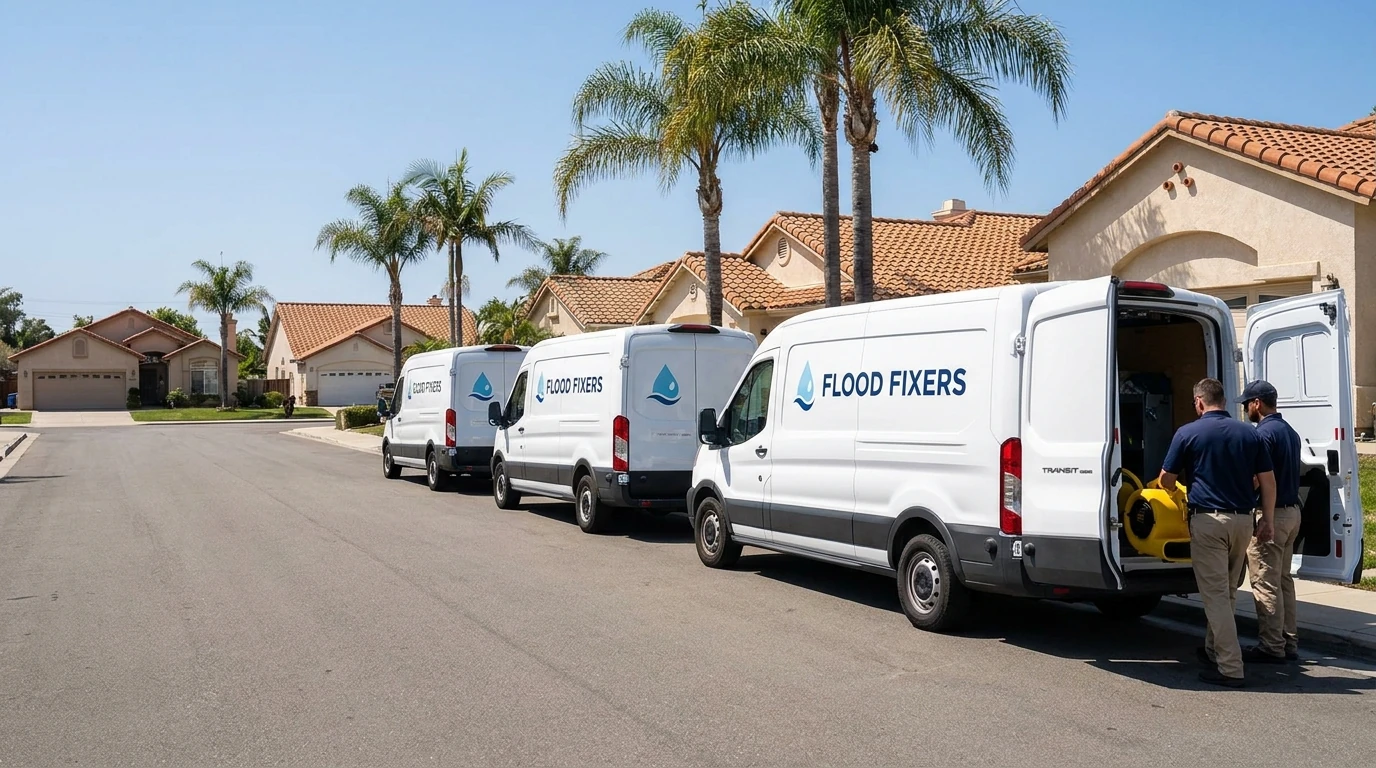
A professional restoration company that works directly with insurance carriers — like Flood Fixers does — can communicate the scope and documentation directly to your adjuster, which typically speeds up the approval process and reduces back-and-forth for you.
What to Do If Your Claim Is Denied
Denials happen, and they’re not always final. If your claim is denied:
- Request the denial in writing with the specific policy language cited.
- Get an independent assessment. A licensed public adjuster (not the same as your insurer’s adjuster) works for you and can re-examine the damage. They typically work on contingency — a percentage of the final settlement.
- Check for an appraisal clause. Most California HO-3 policies include a dispute resolution process that lets both sides hire independent appraisers and resolve disagreements without litigation.
- File a complaint with the California Department of Insurance (insurance.ca.gov) if you believe the denial was in bad faith. California has some of the stronger consumer protections in the country on this front.
Insurance questions are stressful enough without also managing wet flooring, a musty smell that’s getting worse, and a house full of displaced furniture. If you’re dealing with active water damage in the San Diego area and want a clear picture of what you’re working with before you talk to your adjuster, Flood Fixers can walk through the damage with you, provide documentation, and work directly with your insurance carrier. Call (855) 204-1124 — someone picks up around the clock.