
Mold can begin colonizing a wet surface in as little as 24 to 48 hours after water exposure — sometimes faster if the conditions are right. That’s not a scare tactic; it’s the biology. Mold spores are already floating through your home’s air right now, completely harmless until they land on a damp surface with a food source (drywall paper, wood framing, carpet backing). Once moisture gives them what they need, the clock starts. By 72 hours, visible growth is possible. By the end of the first week, a slow leak behind a wall can produce a colony large enough to affect indoor air quality.
Why the 24–48 Hour Window Matters
Most people picture mold as the fuzzy green stuff on old bread, but the mold that follows water damage is usually Cladosporium, Penicillium, Aspergillus, or — in the worst cases — Stachybotrys chartarum (black mold). All of them follow the same growth curve:
- 0–24 hours: Spores settle on wet materials and begin absorbing moisture. No visible sign yet, but germination has started.
- 24–48 hours: Hyphae (the root-like threads) begin penetrating porous surfaces. The material starts to smell musty before you can see anything.
- 3–7 days: Visible colonies appear — white fuzz, gray patches, or dark specks depending on the species. The smell becomes unmistakable.
- 1–4 weeks: Colonies spread laterally and deeper into building materials. At this stage, surface cleaning is no longer enough; affected materials typically need to be removed.
San Diego’s mild, humid marine layer — especially in coastal neighborhoods like Ocean Beach, Mission Hills, and Point Loma — means interior humidity can stay elevated for days after a water event without aggressive drying. That extends the window where mold can take hold.
What Feeds Mold Growth (and What Slows It)
Mold doesn’t need much. It needs three things: moisture, a food source, and temperatures above roughly 40°F. Your home provides all three in abundance after a water event.
Materials that mold loves most:
- Drywall (the paper facing is essentially food)
- OSB and plywood subfloor
- Carpet and carpet pad
- Wood framing and joists
- Ceiling tiles
Materials that are more resistant (but not immune):
- Concrete and masonry (mold can still grow on the dust and organic debris on the surface)
- Metal and glass
- Ceramic tile (the grout, however, is porous)
Temperature also matters. Mold grows fastest between 70°F and 90°F — which is exactly the indoor range in most San Diego homes year-round. Cold slows growth; it doesn’t stop it. And high humidity alone, even without standing water, can be enough. If a room’s relative humidity stays above 60% for several days, surfaces that were never directly wet can still develop mold.
What slows mold growth:
- Dropping indoor humidity below 50% with dehumidifiers
- Increasing airflow through the wet area
- Removing saturated materials quickly
- Lowering the ambient temperature (less practical in a living space)
This is why professional water damage restoration focuses so heavily on drying speed. Industrial air movers and desiccant dehumidifiers aren’t just about getting the floor dry — they’re about collapsing the window before mold can establish.
How to Tell If Mold Has Already Started
If you’re reading this after a recent leak, flood, or appliance failure, here’s what to look for:
You can see it: Early mold often looks like a gray or white powdery haze, not the dramatic black patches people expect. Check corners, the back of baseboards, and anywhere two wet surfaces meet.
You can smell it: A musty, earthy odor — sometimes described as wet cardboard or a damp basement — is usually mold before it’s visible. If a room smells different after water damage, trust your nose.
The wall feels soft or sounds hollow: Press gently on drywall near the water source. Softness or a change in sound when you knock suggests the paper face and gypsum core have absorbed water — prime mold territory.
Paint is bubbling or wallpaper is peeling: Moisture migrating through the wall from the back side causes this. By the time you see it on the surface, the backside may already have growth.
If the water event happened more than 48 hours ago and you haven’t yet started aggressive drying, assume mold has begun and proceed accordingly.
Immediate Steps to Take After Water Damage
These steps are about limiting mold growth — not eliminating a colony that’s already established.
- Stop the water source first. Nothing else matters until the water stops. For a burst pipe, that means the main shutoff valve (usually near the meter at the street or in a utility closet). For an appliance leak, pull the supply line or flip the shutoff behind the unit.
- Remove standing water. A wet/dry shop vac works for small amounts. Towels and mops for thin films. The faster water is off the surface, the slower mold progresses.
- Pull up saturated carpet and pad. Carpet pad is a sponge — it holds moisture for days and is almost impossible to dry in place. Cut it out and remove it. Carpet can sometimes be saved if dried within 24 hours; pad almost never can.
- Open windows and run fans — but only if outdoor humidity is lower than indoor humidity. On a foggy San Diego morning, blowing marine air into a wet room can make things worse. Check the humidity outside before opening up.
- Run your air conditioner. AC removes humidity as it cools. It’s not a substitute for a professional dehumidifier, but it helps.
- Document everything with photos and video before you move or discard anything. Your insurance claim depends on it.
What NOT to do:
- Don’t paint over suspected mold or use bleach on porous materials like drywall. Bleach kills surface mold on non-porous surfaces, but it can’t penetrate drywall or wood — it kills the surface while leaving the roots intact, and the colony regrows.
- Don’t run HVAC through a room you suspect has mold growth. The air handler can pick up spores and distribute them through the entire duct system.
- Don’t wait to see if it dries on its own. “Waiting to see” is how a $3,000 water damage job becomes a $15,000 mold remediation.
When to Call a Professional
DIY drying is appropriate for very small, contained events — a few square feet of wet floor from a slow drip that you caught within hours. For anything larger, or for any situation where:
- The water was present for more than 24 hours before you found it
- The leak is behind drywall, under flooring, or inside a ceiling cavity
- You can already smell a musty odor
- The affected area is more than about 10 square feet
- The water came from a contaminated source (sewage backup, floodwater, HVAC condensate drain)
…professional assessment is the right call. An IICRC-certified water damage technician can use moisture meters and thermal imaging to find water that’s migrated far beyond the visible wet area — the kind of hidden moisture that produces mold colonies inside walls weeks after the surface looks dry.
If mold is already present, remediation is a separate process from drying. It involves containment, HEPA filtration, controlled removal of affected materials, and clearance testing — not something a bottle of bleach and a weekend can address safely.
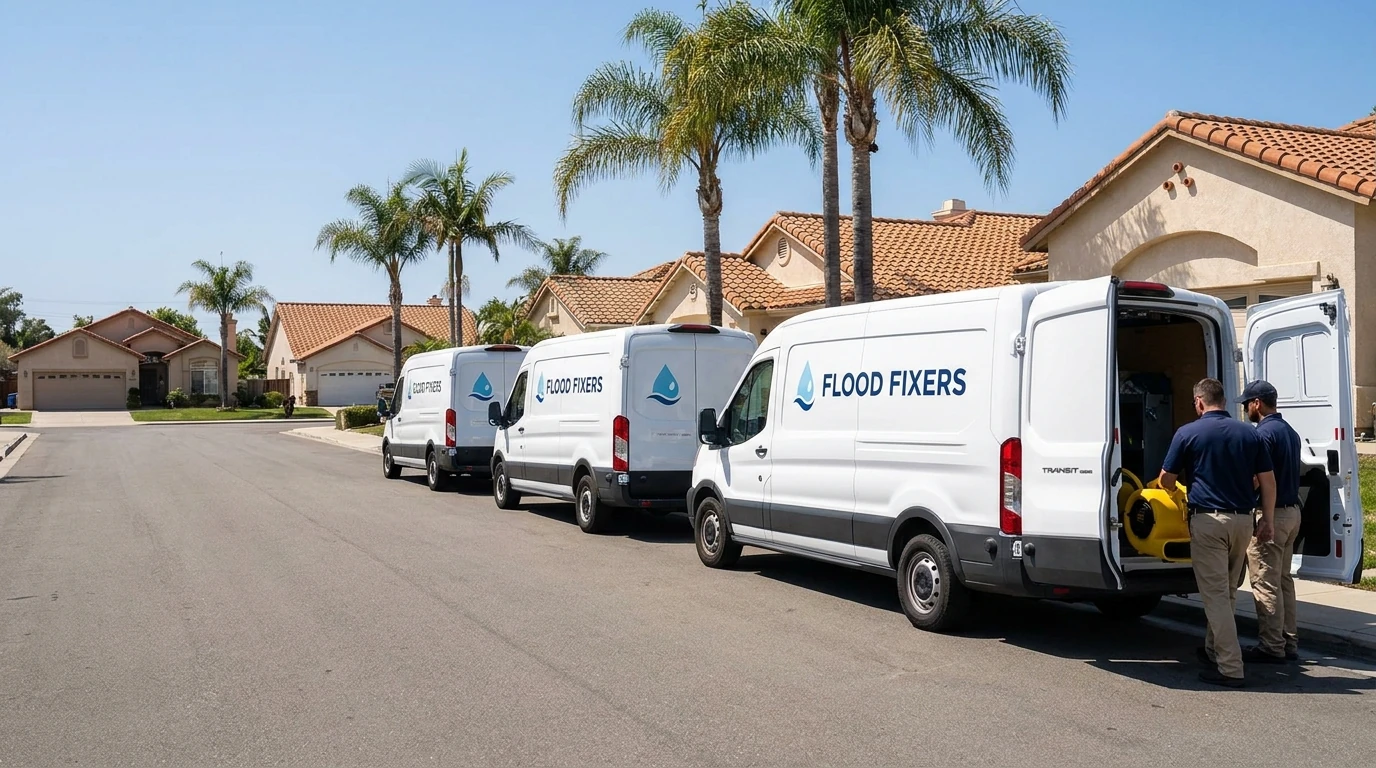
If you’ve had a water event in the last 48 hours — or you’re noticing a smell or stain that appeared after a recent leak — the timeline is working against you. Flood Fixers responds to water damage and mold calls throughout San Diego County, and getting a technician on-site quickly is the single most effective thing you can do to prevent a drying problem from becoming a mold problem. Call (855) 204-1124 any time, day or night.