A commercial water loss can shut down operations in hours. Whether it’s a burst supply line flooding your server room at 2 a.m., a roof drain backing up into a retail floor, or a slow HVAC condensate leak that finally saturates a drop ceiling, the financial clock starts ticking the moment water contacts your building. The good news: businesses that act within the first hour consistently recover faster and with lower total costs than those that wait for morning. This post walks through exactly what to do — and what to avoid — so you can protect your people, your property, and your ability to stay open.
The First 60 Minutes: What You Do Right Now Determines the Recovery
Water damage in a commercial building follows a predictable timeline. In the first 30 minutes, porous materials — carpet padding, drywall, insulation, wood subfloor — begin absorbing moisture. Within a few hours, drywall paper starts to delaminate. By 24–48 hours, mold spores already present in the air can colonize wet surfaces, particularly in San Diego buildings where interior humidity can spike quickly once HVAC is disrupted.
Your immediate priorities, in order:
- Stop the source. Locate the main water shutoff for the affected zone and close it. If you don’t know where it is, call your property manager or the building engineer first — not the restoration company. Every minute of active flow multiplies the affected square footage.
- Cut power to wet areas. Water and live electrical circuits are a life-safety issue. Flip the breakers for any zone where standing water is present. Do not walk through standing water to reach an electrical panel.
- Document before you touch anything. Walk the perimeter with your phone and shoot video of all visible damage — ceiling stains, standing water depth, wet inventory, damaged equipment. This footage is the foundation of your insurance claim.
- Call your insurance carrier. Most commercial policies require prompt notice of loss. Waiting even 24 hours can complicate your claim. Have your policy number ready.
- Call a commercial restoration contractor. This is not the same as calling a general contractor. You need a team with industrial drying equipment — truck-mounted extractors, desiccant dehumidifiers, thermal imaging cameras — not shop vacs and box fans.
What NOT to Do After a Commercial Water Loss
Some of the most expensive mistakes happen in the first few hours, usually because someone is trying to help.
- Don’t run your HVAC system. It feels intuitive to crank the heat or AC to dry things out. In reality, your HVAC will distribute moisture — and any mold spores — throughout the ductwork and into unaffected areas of the building.
- Don’t let employees use wet areas. Slip-and-fall liability is immediate. Wet flooring, even without visible pooling, can be dangerously slick. Cordon off affected zones with caution tape before anyone else enters.
- Don’t throw away damaged materials before documentation. Wet inventory, ruined equipment, and saturated flooring materials all need to be photographed and itemized for your adjuster. Premature disposal can reduce your claim payout.
- Don’t assume it’s dry because it looks dry. A concrete slab can feel dry to the touch while holding significant moisture content below the surface. The same is true for hardwood flooring and gypsum wallboard. Surface appearance is not a reliable indicator — moisture meters and thermal imaging are.
- Don’t use residential-grade equipment. A consumer dehumidifier pulls a few pints of water per day. A commercial LGR (low-grain refrigerant) dehumidifier pulls 100–200 pints per day. Using the wrong equipment doesn’t just slow the drying process — it can allow moisture to migrate into wall cavities and structural members, turning a manageable loss into a gut-and-rebuild.
Understanding Business Interruption: The Hidden Cost of Water Damage
The visible damage — soaked carpet, ruined inventory, warped cabinetry — is only part of the financial picture. For most commercial property owners, the larger exposure is business interruption: lost revenue for every day the space is non-operational.
Most commercial property policies include business interruption (BI) coverage, but the terms vary significantly. Key things to clarify with your adjuster:
- The waiting period. Most BI coverage kicks in after a 48–72 hour waiting period. Days one and two are typically your own exposure.
- The period of restoration. Coverage generally runs until the property is restored to its pre-loss condition — not until your revenue returns to normal. If your tenant base or customer traffic takes months to rebuild after a closure, that gap may not be covered.
- Extra expense coverage. Some policies cover the additional costs of operating from a temporary location during restoration. If you can set up a partial operation elsewhere, this coverage can offset those costs.
A qualified commercial restoration contractor can provide documented drying logs, moisture readings, and scope-of-work reports that directly support your BI claim timeline. Insurers respond better to objective data than to verbal estimates.
What a Professional Commercial Restoration Looks Like
If you’ve never been through a commercial water loss before, the scope of a professional remediation can be surprising. Here’s what to expect once a certified restoration team is on-site:
Day 1–2: Extraction and initial drying setup. Truck-mounted extractors remove standing water. Technicians use thermal imaging cameras to map moisture migration inside walls and under flooring. Industrial air movers and dehumidifiers are positioned based on the moisture map, not just placed randomly.
Days 2–5: Monitored drying. Moisture readings are logged every 24 hours. Equipment is adjusted as materials dry. In San Diego’s mild climate, well-executed commercial drying often hits target moisture levels in 3–5 days for standard construction — longer for concrete slabs, dense insulation, or multi-layer flooring assemblies.
Post-drying: Scope and rebuild. Once materials reach acceptable moisture content (verified by readings, not by feel), the team documents what needs to be replaced versus what can be saved. A reputable commercial restoration contractor will provide a written scope that your adjuster can review before demolition begins.
For large losses — a flooded office floor, a warehouse with several inches of standing water, a multi-tenant building with damage across units — the water damage restoration process may run in parallel with reconstruction on already-dried sections, compressing the overall timeline.
Planning for the Next One: What Businesses Should Have in Place Before a Loss
The businesses that recover fastest from water damage are almost never the ones with the best luck. They’re the ones that had a plan.
- Know your shutoffs. Every manager and key employee should know where the main water shutoff is for their zone. Post a laminated map in the utility room.
- Have a restoration contractor’s number saved. At 2 a.m. on a Sunday, you don’t want to be Googling. Identify a certified commercial restoration contractor before you need one.
- Review your policy annually. Coverage limits, BI waiting periods, and equipment schedules change. A 10-minute conversation with your broker each year is cheaper than discovering a coverage gap during a claim.
- Install water detection sensors. In server rooms, near HVAC units, and under kitchen equipment, inexpensive sensors can alert you to a leak before it becomes a flood.
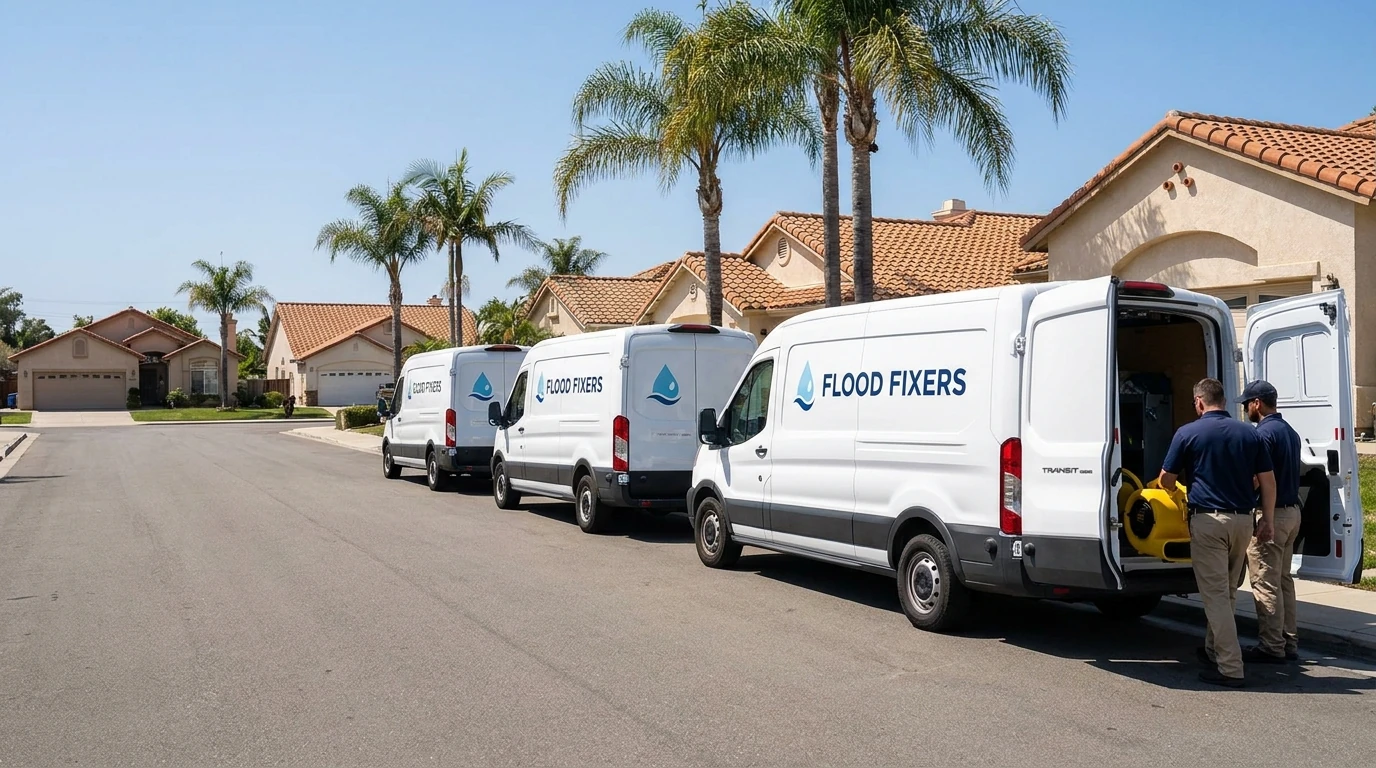
If you’re dealing with an active loss right now, the most useful thing you can do is stop reading and start making calls. Flood Fixers responds to commercial losses throughout San Diego County — reach the team any time at (855) 204-1124.