
Basement Flooding Cleanup in Temecula
24/7 basement flooding cleanup in Temecula, CA. IICRC-certified, insurance billing accepted. Call (855) 204-1124.
Our IICRC-certified technicians are dispatched from our San Diego, CA headquarters and are typically on-site in Temecula within 60 minutes of your call.
Temecula sits in a valley where the Santa Margarita River watershed and the region’s clay-heavy soils create drainage conditions that catch homeowners off guard — especially after the atmospheric river storms that have battered Southwest Riverside County in recent winters. When that water finds its way into a basement, it doesn’t wait. Within 24 to 48 hours, saturated drywall begins to wick moisture upward, wood framing swells, and the warm inland climate accelerates mold colonization faster than coastal areas see. If you’re standing in a wet basement right now, call Flood Fixers at (855) 204-1124.
Why Temecula Properties Experience Basement Flooding
The soil profile across much of Temecula — particularly in the older hillside neighborhoods near Old Town and in the newer developments along Nicolas Road — includes expansive clay layers that don’t drain quickly. During heavy rainfall, that clay becomes nearly impermeable, pushing water laterally toward foundation walls rather than letting it percolate down. Window wells fill in minutes. Sump pumps that sit idle for two or three dry years fail when they’re needed most.
Temecula’s building stock adds another layer of complexity. Homes built in the 1980s and early 1990s boom — which make up a large share of the housing in the 92591 and 92592 ZIP codes — often have basements finished with paper-faced drywall directly against concrete block walls, with minimal vapor barrier between them. When water intrudes, that assembly soaks through fast. Extraction is straightforward, but the drying phase is longer than it looks because moisture migrates behind the drywall into the block cores before you can measure it with a surface moisture meter.
Our Basement Flooding Cleanup Process in Temecula
The first thing a Flood Fixers technician does on arrival is map the water source — whether that’s a failed sump pump, a cracked foundation wall, a backed-up floor drain, or surface water coming in through a window well. That matters because the extraction strategy changes depending on the source, and stopping active intrusion before drying is the only way to avoid doing the same job twice.
From there, the process follows a structured sequence:
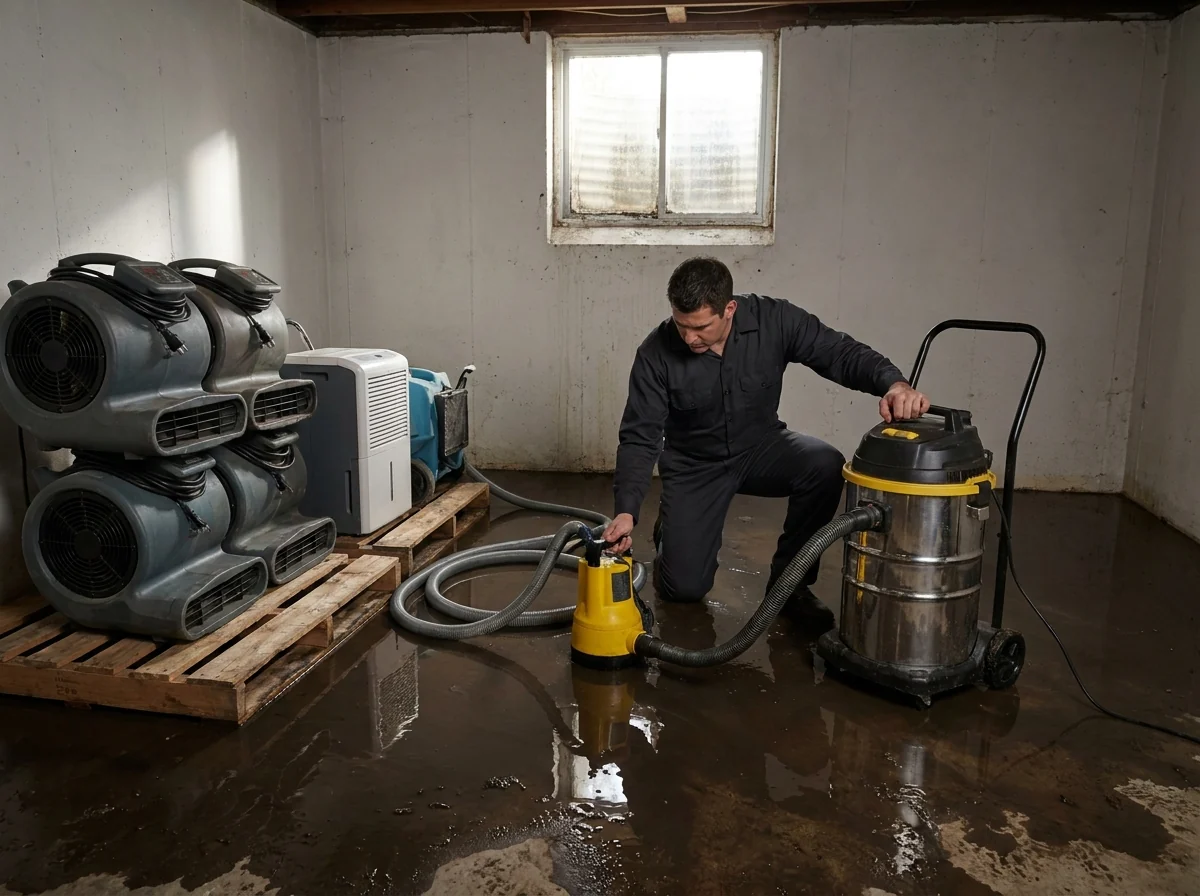
- Standing water extraction using truck-mounted and portable wet-vac units capable of removing hundreds of gallons per hour
- Moisture mapping with thermal imaging cameras and calibrated pin/pinless meters to identify hidden saturation in walls, subfloor assemblies, and concrete block cavities
- Controlled demolition of unsalvageable materials — saturated insulation, paper-faced drywall, and swollen baseboards — documented photographically for your insurance claim
- Drying system placement using industrial-grade desiccant or refrigerant dehumidifiers and high-velocity air movers, positioned based on the moisture map rather than guesswork
- Daily monitoring with written moisture readings until structural materials reach target dryness levels per IICRC S500 standards
In Temecula’s summer heat, interior temperatures in a closed basement can exceed 85°F, which actually speeds drying — but it also accelerates microbial growth in any material left damp. We calibrate equipment placement to take advantage of the heat without letting humidity levels spike.
Response Time to Temecula
Flood Fixers dispatches from San Diego, and Temecula is a priority corridor. Under normal traffic conditions, a technician can reach most of the city in 60 to 75 minutes via I-15 North. During peak commute hours on the I-15 — which can turn the Rancho California Road interchange into a genuine bottleneck — we route through surface streets and communicate an honest ETA rather than an optimistic one.
For properties in the Redhawk and Vail Ranch areas on the southern end of Temecula, arrival times typically run closer to 55 minutes. For addresses further north near Harveston or the Temecula Valley Hospital corridor, plan for 70 to 80 minutes. Either way, you’ll have a technician’s direct number the moment dispatch confirms your call.
Local Note: What Temecula’s Dry Summers Do to Basement Waterproofing
Here’s something that surprises homeowners: Temecula’s long dry season — often six or more months with almost no measurable rain — causes the clay soil around foundations to shrink and pull away from basement walls. That gap closes rapidly when the rains return, but in the meantime, hairline cracks in foundation walls that were sealed and forgotten can open just enough to let the first heavy storm push water through at pressure. We see this pattern repeatedly in the older ranch-style homes near Old Town Temecula and in the Paloma del Sol community, where the soil movement is pronounced. If your basement flooded during the first significant storm of the season after a dry stretch, that shrink-swell cycle is the likely culprit — and it’s worth addressing the crack before the next rain, not after.
Temecula Insurance Coordination
Most standard homeowners policies in California cover sudden and accidental water damage — a burst pipe, a failed sump pump — but exclude gradual seepage or flooding from surface water without a separate flood policy. We document everything from the first hour on-site: photos, moisture readings, equipment logs, and a written scope of damage. That file goes directly to your adjuster in whatever format they require. We work with all major carriers and have handled claims through Farmers, AAA, and State Farm offices that serve the Temecula and Murrieta area regularly.
Call (855) 204-1124 the moment water appears in your basement — every hour of delay in Temecula’s climate extends the drying timeline and the cost of the job.
Serving Temecula from our San Diego headquarters — ★ 5.0 · 9 Google reviews
“Flood Fixers completely saved my home and my sanity. I experienced an extreme upstairs bathroom leak that could have caused catastrophic damage, but their team responded immediately. They arrived fast, assessed the situation with total professionalism, and went straight to work.The technicians were…” — Nigel, May 2026
Basement Flooding Cleanup in Temecula: Service Coverage Map
Frequently Asked Questions
How fast can you arrive for basement flooding cleanup in Temecula?
How quickly can Flood Fixers reach the Redhawk or Vail Ranch areas of Temecula for a basement flooding emergency?
Temecula had a major atmospheric river storm last winter. Does seasonal storm flooding affect what's covered by my homeowners insurance?
Are homes in the 92591 ZIP code more prone to basement moisture problems than newer Temecula developments?
How long does basement drying actually take in Temecula's climate?
The soil around my Old Town Temecula home seems to shift a lot seasonally. Could that be causing my basement to flood?
Basement Flooding Cleanup response in Temecula
Most Temecula calls see a technician on-site within 60 minutes from our San Diego headquarters.