
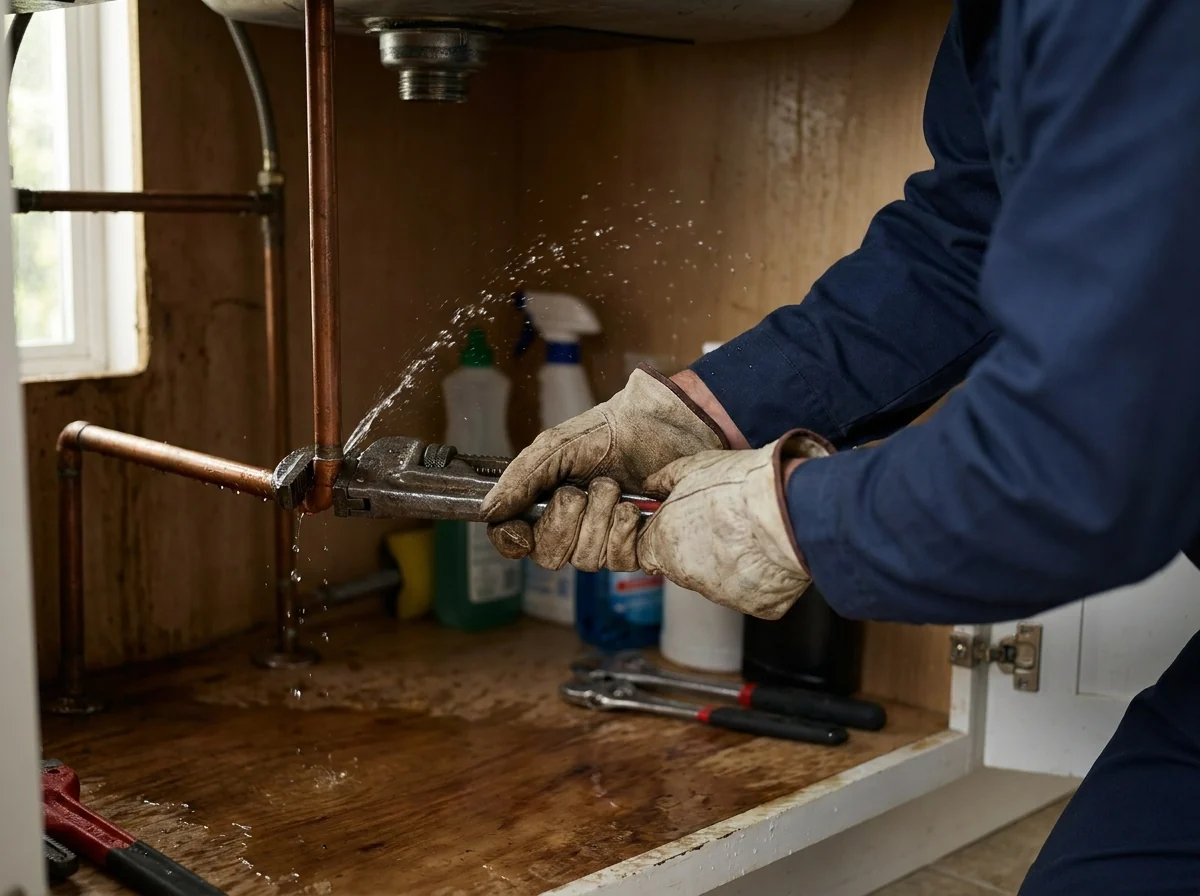
Burst Pipe Cleanup and Repair in Spring Valley
24/7 burst pipe cleanup and repair in Spring Valley, CA. IICRC-certified, insurance billing accepted. Call (855) 204-1124.
Our IICRC-certified technicians are dispatched from our San Diego, CA headquarters and are typically on-site in Spring Valley within 60 minutes of your call.
Spring Valley sits in one of San Diego County’s inland microclimates where summer temperatures regularly push past 95°F and then drop sharply overnight — that thermal cycling puts real stress on supply lines, especially in the older ranch-style homes that make up much of the housing stock east of Campo Road. When a pipe lets go at 2 a.m. and water is spreading across hardwood floors or soaking into a stucco-and-lathe wall, the clock matters more than anything else. Flood Fixers responds to burst pipe emergencies throughout Spring Valley, and the team knows what it’s walking into before it arrives.
Why Spring Valley Homes See More Burst Pipe Damage Than Coastal Neighborhoods
The homes built across Spring Valley between the 1950s and early 1980s were largely plumbed with galvanized steel supply lines. Galvanized pipe corrodes from the inside out — rust builds up, narrows the bore, and eventually the pipe wall thins until pressure wins. Many of these lines have never been replaced, and homeowners often don’t know what’s behind their walls until something fails catastrophically.
The inland heat also plays a role most people don’t expect. Copper and CPVC expand and contract more aggressively in Spring Valley’s temperature swings than they do closer to the coast where the marine layer keeps temperatures stable. Fittings that were fine for years can work loose after enough seasons of that movement. Add the region’s periodic freeze events — rare, but real at Spring Valley’s elevation — and you have conditions that push pipes past their limits in ways that coastal San Diego rarely sees.
Slab-on-grade construction, common throughout the unincorporated county areas here, means that when a supply line under the slab fails, water migrates along the path of least resistance — sometimes surfacing 20 feet from the actual break. Locating the source requires listening equipment and thermal imaging, not guesswork.
Our Burst Pipe Cleanup and Repair Process in Spring Valley
The first thing a Flood Fixers technician does on arrival is locate and confirm the break — not just mop up the visible water. Using acoustic leak detection and infrared cameras, the team traces the pipe failure to its source, which is especially important in slab-foundation homes where the break and the wet spot are rarely in the same place.
Once the source is confirmed and the water is shut off, the process moves in a specific order:
- Extract standing water — truck-mounted extraction pulls water from flooring, subfloor, and low-lying areas before it wicks further into wall cavities.
- Document and photograph — every affected surface is logged for the insurance claim before any material is moved or removed.
- Set drying equipment — industrial air movers and low-grain refrigerant dehumidifiers are placed based on a moisture map of the structure, not a standard formula.
- Coordinate pipe repair — Flood Fixers works with licensed plumbers to get the broken line repaired or rerouted while drying is underway, so the two scopes don’t create scheduling delays.
- Monitor daily — moisture readings are taken and logged each day until the structure reaches dry standard, typically three to five days depending on materials and how long the pipe was running before discovery.
In Spring Valley’s older stucco homes, drying timelines run longer than in modern drywall construction. Stucco and the brown coat beneath it hold moisture stubbornly — plan for an extra day or two compared with a newer build.
Response Time to Spring Valley
Flood Fixers is based in San Diego, and Spring Valley sits roughly 12 miles east of downtown via I-8 and SR-125 — under normal traffic conditions, that’s a 20-to-25-minute drive. During peak commute hours on the 125 corridor, the team uses surface routes through La Mesa and Lemon Grove to avoid the interchange backup near the 8/94 split.
For addresses deeper into the community — toward the Spring Valley Community Center area or south along Jamacha Road — expect an on-site arrival within 45 minutes of your call in most circumstances. The team dispatches with equipment loaded, so there’s no return trip to a warehouse once they reach your address. Call (855) 204-1124 any hour; the line is staffed around the clock.
Local Note: What Spring Valley’s Soil Does to Slab Leaks
Spring Valley and the surrounding unincorporated areas sit on expansive clay soils that swell when wet and shrink when dry. When a slab leak runs undetected for days — common when the break is slow and the homeowner notices only a higher water bill — that moisture movement can cause the slab itself to shift slightly. The result is sometimes a crack in tile or a door that suddenly won’t close, symptoms that look structural but trace back to a plumbing failure. If you’re seeing those signs alongside a spike in your Helix Water District bill, a pipe break under the slab is worth ruling out before anything else.
Flood Fixers technicians working in the 91977 ZIP code have seen this pattern enough times to check for slab movement during the initial assessment — it affects how drying equipment is positioned and whether a structural engineer referral is warranted alongside the plumbing repair.
If a burst pipe has already reached your floors, walls, or crawl space, the damage compounds every hour it sits. Call (855) 204-1124 now — the Flood Fixers team can be in Spring Valley fast, with the equipment to stop the spread and the documentation to support your insurance claim from the first hour on-site.
Serving Spring Valley from our San Diego headquarters — ★ 5.0 · 9 Google reviews
“Flood Fixers completely saved my home and my sanity. I experienced an extreme upstairs bathroom leak that could have caused catastrophic damage, but their team responded immediately. They arrived fast, assessed the situation with total professionalism, and went straight to work.The technicians were…” — Nigel, May 2026
Burst Pipe Cleanup and Repair in Spring Valley: Service Coverage Map
Frequently Asked Questions
How fast can you arrive for burst pipe cleanup and repair in Spring Valley?
How quickly can Flood Fixers reach a burst pipe emergency in the Spring Valley area near Jamacha Road?
Spring Valley has a lot of homes built in the 1960s and 70s — are those more likely to have serious damage from a burst pipe?
My Helix Water District bill spiked but I don't see any obvious flooding — could I still have a burst pipe?
What does the drying process actually look like inside a Spring Valley home after a pipe bursts?
Will Flood Fixers handle the insurance paperwork for a burst pipe claim in Spring Valley, or do I have to manage that myself?
Burst Pipe Cleanup and Repair response in Spring Valley
Most Spring Valley calls see a technician on-site within 60 minutes from our San Diego headquarters.