
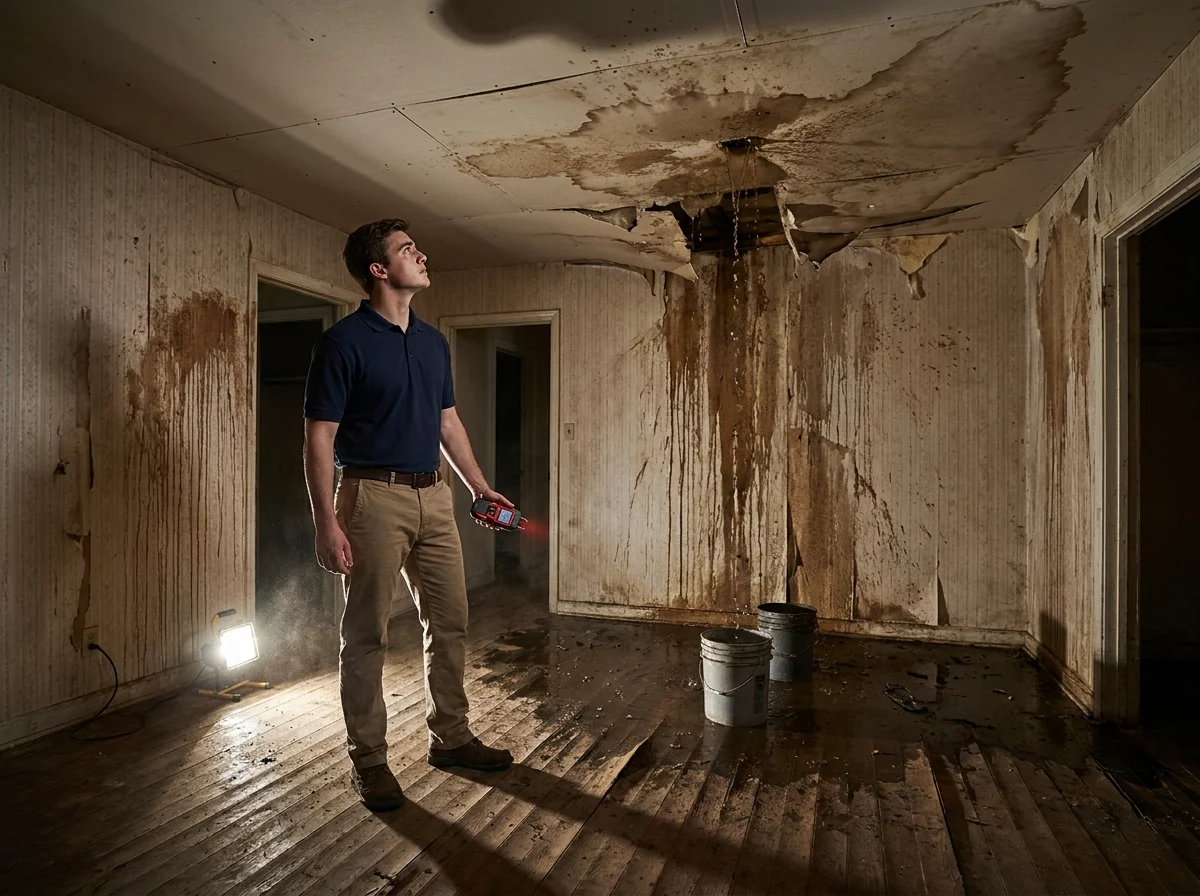
Water Damage Restoration in Santee
24/7 water damage restoration in Santee, CA. IICRC-certified, insurance billing accepted. Call (855) 204-1124.
Our IICRC-certified technicians are dispatched from our San Diego, CA headquarters and are typically on-site in Santee within 60 minutes of your call.
Santee sits in a semi-arid inland valley, but that dry reputation is exactly what catches homeowners off guard. When a water heater fails in a slab-on-grade ranch home off Cuyamaca Street, or a supply line bursts inside a 1970s tract house near Town Center Community Park, the hard caliche soil underneath has nowhere to send the water — it pools, it wicks into drywall, and within 24 to 48 hours mold colonization begins. Flood Fixers responds to water emergencies across Santee’s 92071 ZIP code around the clock, with the equipment and trained technicians to stop damage before it compounds.
Why Santee Properties Are Vulnerable to Water Damage
Santee’s housing stock tells the story. The majority of single-family homes here were built between the late 1960s and early 1990s, a period when polybutylene and galvanized steel supply lines were standard. Both materials are well past their service life and prone to sudden failure — not a slow drip you notice on a Tuesday morning, but a full rupture that can release hundreds of gallons before the main is shut off.
The region’s climate adds another layer of risk. Santee averages fewer than 15 inches of rain per year, but when storms do arrive — often as atmospheric river events that dump two or three inches in a single day — older drainage infrastructure and compacted soil can’t absorb runoff fast enough. Water intrudes through garage slabs, low-set window wells, and the crawl spaces still found under some of the older homes near Mast Boulevard. Residents who rarely think about flooding suddenly have standing water in rooms they use every day.
HVAC condensate lines are another underappreciated culprit in Santee’s warm inland climate. Systems run hard from May through October, and a clogged condensate drain can silently saturate attic insulation or ceiling drywall for weeks before the stain appears.
Our Water Damage Restoration Process in Santee
Every job starts with a moisture assessment — not a visual scan, but thermal imaging and calibrated moisture meters mapped room by room. That data drives every decision that follows.
Water extraction comes first. Truck-mounted extractors pull standing water from carpet, hardwood, and tile at a rate that shop vacs and consumer wet-dry units simply can’t match. For slab-on-grade homes common throughout Santee, we pay close attention to water that has migrated under flooring and into the subfloor system — it’s invisible until you measure for it.
Structural drying follows extraction. Industrial-grade desiccant and refrigerant dehumidifiers, combined with high-velocity air movers, are positioned based on the moisture map, not guesswork. We monitor readings daily and adjust equipment placement as materials dry — a process that typically runs three to five days for a contained loss, longer for Category 2 or 3 water events.
Documentation runs parallel to every step. Moisture readings, photos, and equipment logs are compiled in a format that insurance adjusters can work with directly, which shortens the claims cycle for Santee homeowners dealing with carriers like AAA, Farmers, and State Farm — all common in this market.
Response Time to Santee
From our San Diego base, Santee is typically a 25-to-35-minute drive via SR-52 East or Mission Gorge Road depending on traffic. For calls that come in during peak commute hours on I-8 or SR-67, we route accordingly. Our target is a technician on-site within 60 minutes of your call for most Santee addresses — faster for locations close to the SR-52 / Cuyamaca Street corridor.
We answer live, 24 hours a day. When you call (855) 204-1124 at 2 a.m. because water is spreading across your kitchen floor, you reach a person who can dispatch a crew, not a voicemail box.
Local Note: What Santee’s Soil Does to Drying Timelines
Here’s something that doesn’t show up in generic restoration guides: Santee’s expansive clay soils retain moisture and transmit it slowly upward through concrete slabs, a process called capillary wicking. Even after surface water is extracted and visible materials test dry, the slab itself can continue releasing moisture vapor into flooring adhesives and the bottom plates of interior walls for days. We account for this by extending monitoring periods on slab-on-grade homes and, when readings warrant it, deploying desiccant dehumidifiers specifically rated for vapor-phase drying — not just liquid water removal. Skipping this step is one of the most common reasons Santee homeowners see secondary mold issues weeks after a “completed” restoration job.
If your home near Santee Lakes or along the Mast Boulevard corridor has experienced a water loss, don’t wait to see whether things dry on their own. Call Flood Fixers at (855) 204-1124 — the sooner structural drying begins, the narrower the scope of repairs, and the lower the final cost to you and your insurer.
Serving Santee from our San Diego headquarters — ★ 5.0 · 9 Google reviews
“Great work by the Flood Fixer team. Highly recommend.” — Maryann, May 2026
Water Damage Restoration in Santee: Service Coverage Map
Frequently Asked Questions
How fast can you arrive for water damage restoration in Santee?
How quickly can Flood Fixers reach a home near Santee Lakes after a water emergency?
Santee has a lot of 1970s and 1980s tract homes — does older construction change how water damage restoration works?
Does Santee's dry climate mean water damage dries out on its own faster?
How does the insurance claims process typically work for water damage in Santee's 92071 ZIP code?
What's the difference between water extraction and structural drying, and do I need both?
Water Damage Restoration response in Santee
Most Santee calls see a technician on-site within 60 minutes from our San Diego headquarters.