
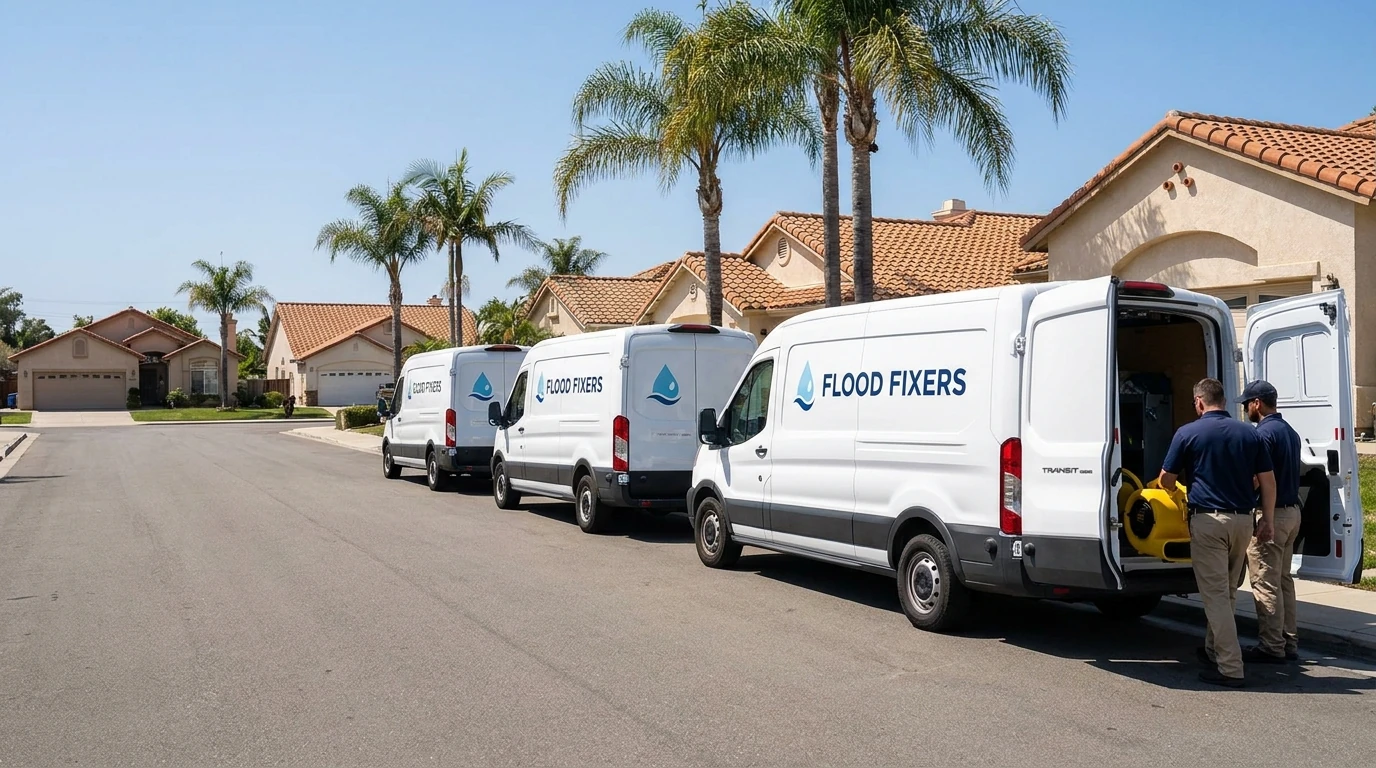
Reconstruction Services in San Diego
24/7 reconstruction services in San Diego, CA. IICRC-certified, insurance billing accepted. Call (855) 204-1124.
Our technicians are headquartered right here in San Diego and are typically on-site within 60 minutes of your call.
San Diego’s combination of Pacific moisture, Santa Ana wind events, and a housing stock that ranges from 1920s Craftsman bungalows in North Park to post-fire rebuilds in the inland foothills creates reconstruction challenges you won’t find in most other California markets. When a water intrusion, fire, or structural failure leaves a property partially or fully uninhabitable, the path back to livable isn’t just demolition and drywall — it’s navigating local permitting timelines, seismic retrofit requirements, and in many cases, HOA architectural review before a single stud goes up. Flood Fixers operates out of San Diego and handles the full scope of post-damage reconstruction, from structural framing through final finishes, so property owners aren’t left managing a revolving door of subcontractors.
Why San Diego Properties Face Distinct Reconstruction Demands
The geology under much of San Diego is expansive clay soil — it swells when wet and contracts during dry stretches. That cycle quietly stresses foundations and stem walls over decades, and when a plumbing failure or roof breach introduces sustained moisture, the structural damage that surfaces during demolition is often worse than the initial loss suggested. Properties in hillside neighborhoods like Kensington and Mission Hills sit on cut-and-fill lots where soil movement is amplified; reconstruction scopes on those sites routinely require a soils report and sometimes a geotechnical engineer’s sign-off before the city will issue a building permit.
Santa Ana conditions add a separate layer of complexity. The low-humidity, high-wind events that push fire risk into the red every fall also dry out wood framing and stucco faster than contractors expect — which matters for moisture-sensitive materials installed during or after remediation. Getting sequencing right (drying verified before enclosure, stucco lath inspected before scratch coat) is the difference between a clean rebuild and a callback six months later.
The Reconstruction Process in San Diego
Every post-damage rebuild starts with a documented scope — not an estimate scribbled on a clipboard, but a line-item breakdown tied to the adjuster’s report and the local building department’s requirements. San Diego’s Development Services Department (DSD) has moved most permit applications online, but response times on over-the-counter structural permits still run several business days, and larger scopes that trigger plan check can add two to four weeks. Flood Fixers builds those windows into the project schedule upfront so property owners aren’t blindsided.
The field sequence typically runs: hazardous material assessment (asbestos and lead are common in pre-1978 construction throughout 92104 and surrounding zip codes), selective demolition, rough framing and structural repairs, mechanical and electrical rough-in, city inspections, insulation, drywall, and finishes. On fire-damaged properties, odor-sealing primers go on every framed surface before enclosure — skipping that step is the single most common reason a rebuilt home still smells like smoke two years later. For commercial properties, ADA path-of-travel upgrades are often triggered once the valuation of reconstruction work crosses a code threshold, and Flood Fixers coordinates that scope with the design team early rather than discovering it at permit intake.
San Diego Insurance and HOA Coordination
Most residential losses in San Diego run through standard homeowners policies, but the claim experience varies significantly depending on whether the carrier uses a preferred vendor program or allows the homeowner to choose their own contractor. Flood Fixers works directly with adjusters, provides Xactimate-formatted estimates, and supplements claims when hidden damage surfaces during demolition — a common occurrence on older stucco construction where water has been traveling inside wall cavities for longer than the visible damage suggests.
For properties governed by an HOA — and a significant share of San Diego’s attached housing, from Mission Valley condos to coastal townhomes, falls into this category — reconstruction that changes exterior materials, rooflines, or window configurations typically requires architectural committee approval before permits can be pulled. That review process can add two to six weeks to a project timeline if it isn’t started immediately after the loss. Flood Fixers flags HOA requirements at the intake call and submits the documentation package in parallel with the insurance claim.
Local Note
In neighborhoods like North Park and South Park, where a large share of the housing stock was built between 1920 and 1945, original stucco is often a three-coat portland cement system applied directly over wood lath — not the modern two-coat finish over foam board you’d find in a 1990s tract home. When fire or water damages those walls, matching the texture and hardness of the original scratch and brown coat takes a plasterer with specific experience, not just a drywall crew with a texture sprayer. Flood Fixers sources tradespeople familiar with historic stucco systems when the scope calls for it, which matters both for aesthetics and for passing city inspection on a like-for-like repair.
If your San Diego property has been damaged and you’re looking at a partial or full rebuild, the sooner the reconstruction scope is defined, the sooner the permit clock starts. Call Flood Fixers at (855) 204-1124 — the team is based here, knows the local permit process, and can have an estimator on-site the same day to start documenting what comes next.
Reconstruction Services in San Diego: Service Coverage Map
Frequently Asked Questions
How fast can you arrive for reconstruction services in San Diego?
How does San Diego's permitting process affect reconstruction timelines?
Are properties in hillside neighborhoods like Kensington or Mission Hills harder to reconstruct after structural damage?
Does fire damage reconstruction in San Diego require anything beyond standard rebuild work?
My property in the 92104 ZIP code was built in the 1930s. Does that change what's involved in post-damage reconstruction?
How does HOA oversight affect post-disaster rebuilding for San Diego condo or townhome owners?
Will my homeowners insurance cover reconstruction services in San Diego?