
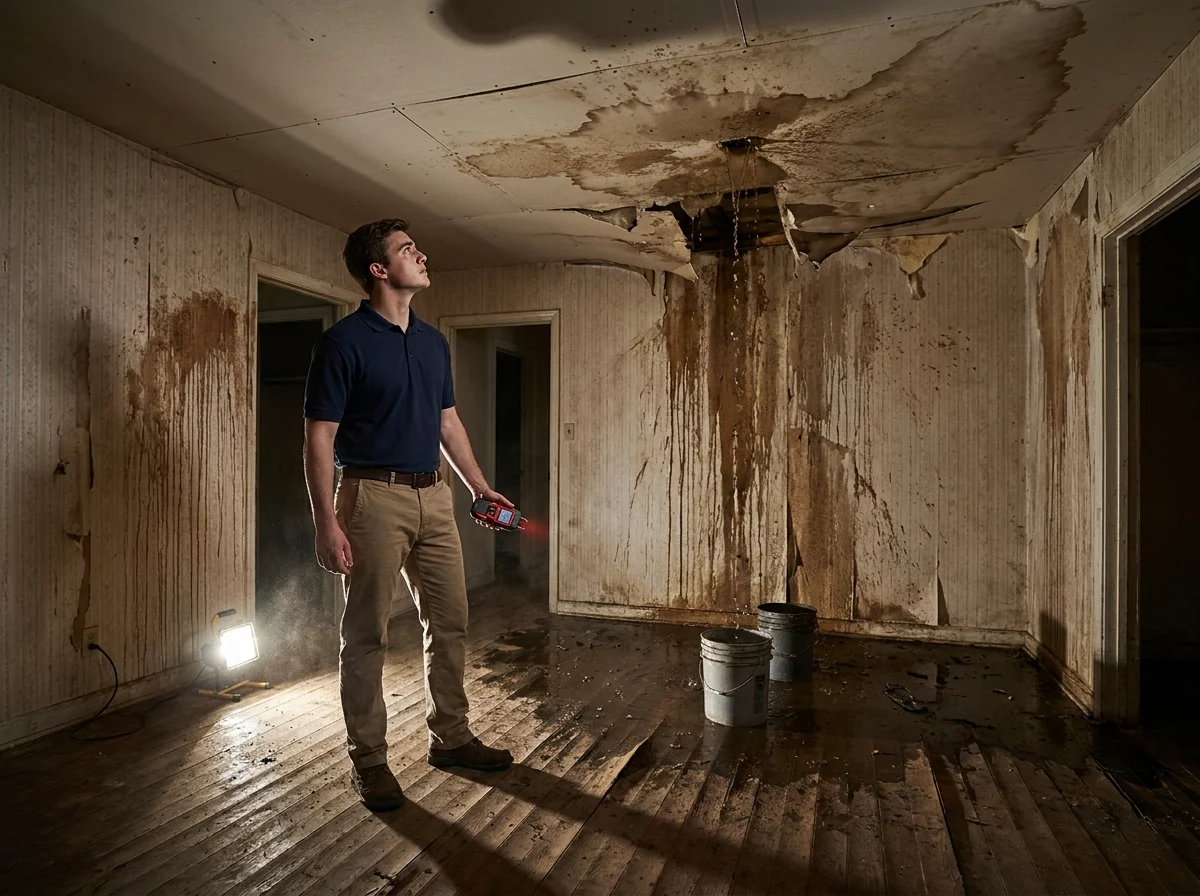
Water Damage Restoration in La Mesa
24/7 water damage restoration in La Mesa, CA. IICRC-certified, insurance billing accepted. Call (855) 204-1124.
Our IICRC-certified technicians are dispatched from our San Diego, CA headquarters and are typically on-site in La Mesa within 60 minutes of your call.
La Mesa sits in a bowl-shaped valley where summer thunderstorms drain fast and hard off the slopes above Spring Street, and where the city’s older residential streets — many lined with homes built in the 1950s and 1960s — funnel runoff directly toward foundations and crawl spaces. When a water event hits here, whether it’s a ruptured supply line in a hillside ranch house or storm intrusion through an aging slab, the damage moves quickly. Flood Fixers responds to water damage emergencies throughout La Mesa, typically on-site within 60–90 minutes of your call to (855) 204-1124.
Why La Mesa Properties See Water Damage Differently
The geology under La Mesa is largely decomposed granite — a soil type that drains poorly once it’s saturated and expands slightly when wet. That matters because slab foundations, common throughout the 91941 and 91942 ZIP codes, sit directly on this soil. When a slow leak goes undetected under a kitchen or bathroom, the moisture doesn’t just evaporate — it migrates laterally under the slab, wicking into adjacent rooms and creating hidden wet zones that a surface inspection won’t catch.
The housing stock adds another layer of complexity. Many homes in the neighborhoods near La Mesa Village and along University Avenue were built before modern vapor barriers and moisture-resistant drywall were standard. Original drywall in these homes is often a thicker, paper-faced gypsum that absorbs water more aggressively than contemporary board. It can look dry on the surface within 24 hours while still holding moisture at the core — which is exactly the condition that lets mold colonize within 48 to 72 hours of initial exposure.
San Diego Gas & Electric (SDG&E) serves La Mesa, and on jobs involving water intrusion near electrical panels or subfloor wiring, we coordinate shutoff or safe-access procedures before equipment staging begins. That’s not a formality — it’s a step that protects both the crew and the home.
Our Water Damage Restoration Process in La Mesa
Every job starts with thermal imaging and moisture mapping, not a visual walkthrough. In La Mesa’s older slab homes, that distinction matters — we’ve found moisture plumes extending six to eight feet from a visible water source, hidden beneath tile and original hardwood. Once we know the full scope, extraction comes first: truck-mounted and portable units pull standing water from flooring, subfloor cavities, and wall cavities before any drying equipment is placed.
Structural drying in La Mesa’s climate is generally efficient — low ambient humidity helps — but slab construction slows the process because concrete releases moisture slowly and in all directions. We use desiccant and refrigerant dehumidifiers in combination, positioned based on the moisture map rather than room count, and we monitor readings every 24 hours with calibrated meters. Drying typically runs three to five days for a contained event; larger intrusions or those involving crawl spaces can run seven to ten.
Throughout the process, we document every moisture reading, equipment placement, and daily log entry in a format compatible with most insurance carriers’ requirements — which simplifies the claim process considerably.
Response Time to La Mesa from Our San Diego Base
Flood Fixers operates out of San Diego, and La Mesa is one of our closest service areas — roughly 10 to 15 minutes from our dispatch point under normal freeway conditions on I-8 East. During peak traffic windows, our crews use surface routes through El Cajon Boulevard or Spring Street to avoid the interchange backup near 70th Street. For addresses in the hills above Lake Murray Boulevard or in the Rolando Park area, we factor in the surface-street approach and still target a 60-minute arrival.
When you call, give us the cross street or nearest landmark — it helps us route the right truck and the right equipment load for your specific address.
Working with Insurance on La Mesa Water Claims
Most standard homeowners policies in California cover sudden and accidental water discharge — a burst pipe, a failed appliance supply line, an overflow — but exclude gradual leaks. La Mesa homeowners sometimes discover a slow leak behind a wall that’s been active for weeks; in those cases, coverage depends on the specific policy language and when the damage became “discoverable.” We don’t make coverage determinations, but we document the physical evidence thoroughly so your adjuster has a complete picture.
We work directly with all major carriers and can submit the scope of work, moisture logs, and photo documentation in the format most adjusters prefer. If your property is part of an HOA, we’ll coordinate with the association’s property manager on access, shared-wall documentation, and any required third-party sign-off before closing out the job.
Local Note
In the blocks around La Mesa Village, a number of commercial-to-residential conversions and older mixed-use buildings have original clay-tile drainage lines running beneath the structure. These lines are prone to root intrusion and partial collapse, and when they back up, the resulting water event often looks like a plumbing failure but is actually a drain-system issue. We flag this during the initial assessment because the remediation scope — and the insurance documentation — differs significantly depending on the source. If you’re in an older building near the Village core and you’re seeing unexplained moisture at the base of interior walls, the drain line is worth investigating before any restoration work begins.
Serving La Mesa from our San Diego headquarters — ★ 5.0 · 9 Google reviews
“Absolutely blown away by Flood Fixers! ⭐⭐⭐⭐⭐ They swooped in after our disaster like a team of caffeinated superheroes and brought a level of creative flair I didn’t even know my home needed. The floors? Let’s just say they now have a one-of-a-kind, “you’ll never see this anywhere else” finish. The…” — Jeffrey, May 2026
Water Damage Restoration in La Mesa: Service Coverage Map
Frequently Asked Questions
How fast can you arrive for water damage restoration in La Mesa?
How quickly can Flood Fixers reach a home in the La Mesa Village area after a water emergency?
Are La Mesa homes in the 91941 ZIP code more vulnerable to under-slab moisture migration?
Does the older housing stock near La Mesa Village affect how long structural drying takes?
How does La Mesa's slab construction change the water extraction and drying process compared to homes with crawl spaces?
If my La Mesa home has water damage from a slow leak rather than a sudden pipe burst, will my insurance cover it?
Water Damage Restoration response in La Mesa
Most La Mesa calls see a technician on-site within 60 minutes from our San Diego headquarters.